Why Familiarity Can Be More Terrifying Than Monsters in Horror Fiction
How to Create Horror Through Atmosphere Instead of Gore
Horror is frequently associated with excess. Monsters, violence, possession, grotesque transformation — the genre is often imagined through forms of visible rupture, where fear emerges from something unmistakably abnormal entering ordinary life. Yet some of the most enduring works of horror rely on a very different mechanism. Rather than confronting readers with the unfamiliar, they force them to reconsider what already feels known.
This approach sits at the heart of much psychological horror. The disturbing element is not necessarily an external threat but a gradual shift in perception. Something ordinary begins to feel wrong without ever becoming entirely unrecognizable. A relationship, a house, a routine, a conversation — all remain outwardly intact, yet the reader senses that something beneath their familiar surface has become unstable.
The effectiveness of this technique stems largely from the way familiarity shapes expectation. Readers instinctively lower their guard around ordinary environments. Domestic spaces, daily rituals, and recognizable social interactions carry assumptions of safety, or at least predictability. When horror emerges from within those structures rather than invading them from the outside, it becomes more difficult to isolate and understand. The threat is no longer a separate presence. It is embedded within the fabric of normality itself.
Psychological Horror and the Power of the Uncanny
This is closely related to what literary critics have long described as the uncanny. The uncanny does not arise from complete unfamiliarity. It emerges when something feels simultaneously recognizable and wrong. The experience creates a form of cognitive tension because the mind struggles to reconcile what it knows with what it senses.
In horror fiction, this effect rarely depends on dramatic revelations. A repeated phrase acquires a different meaning. A familiar room begins to feel oppressive. A routine interaction develops subtle emotional dissonance. Nothing overtly supernatural may occur, yet the atmosphere becomes increasingly unbearable. The familiar remains visible, but it can no longer be experienced in the same way.
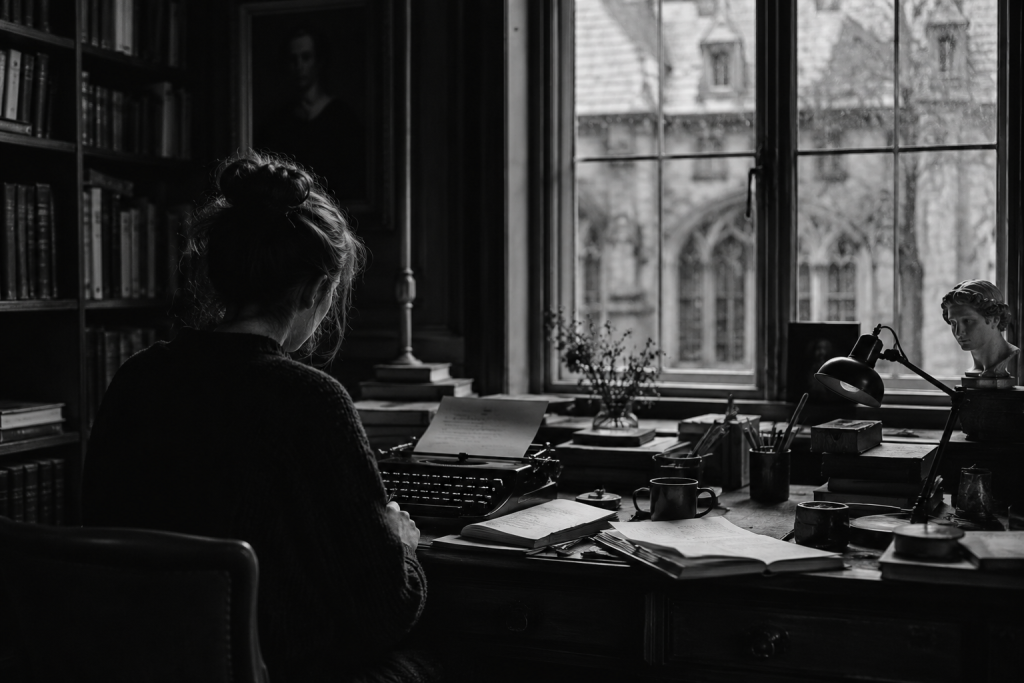
Many successful horror narratives rely on this gradual destabilization rather than immediate shock. Instead of presenting a clearly defined source of fear, they encourage readers to detect patterns they cannot fully explain. The threat exists in implication, accumulation, and uncertainty. As a result, the reading experience becomes less about confronting danger and more about enduring the psychological pressure created by its possibility.
Dialogue frequently contributes to this process. Conversations remain outwardly normal, but something in their rhythm feels slightly misaligned. Characters avoid certain topics, respond indirectly, or communicate in ways that seem technically appropriate while concealing deeper tensions. The reader becomes aware that language is failing to express something important, and that gap between words and meaning generates unease of its own.
How Atmosphere Creates Fear in Everyday Settings
Atmosphere becomes particularly important when horror operates through familiarity. Unlike horror that depends on spectacle or confrontation, atmospheric horror derives much of its power from emotional conditioning. Small details accumulate until they acquire disproportionate significance. A recurring sound, an unchanged object, a repeated gesture — none of these elements are frightening in isolation, but repetition gradually transforms them into sources of tension.
This use of repetition is especially effective because familiarity itself is built through recurrence. Horror fiction can exploit that relationship by turning ordinary patterns against the reader. The object does not become frightening because it changes. It becomes frightening because it remains the same while everything around it begins to feel different.
There is also a deeply intimate quality to this kind of horror. Traditional monsters remain external. They can be identified, confronted, and separated from everyday life. Horror rooted in familiarity functions differently because it draws upon emotional structures that already exist within ordinary experience: isolation, resentment, dependency, grief, routine, silence, and unresolved conflict. The genre begins to feel less like an encounter with something impossible and more like an exposure of tensions that have always existed beneath the surface.
This is one reason domestic horror has become such a powerful subgenre in contemporary fiction. The home is traditionally associated with security, stability, and belonging. When those assumptions become unreliable, readers experience a particularly unsettling form of vulnerability. The very spaces designed to provide comfort become sources of uncertainty.
What distinguishes this approach from simple realism is not the absence of strange or unsettling elements, but the way those elements remain embedded within ordinary perception. The world does not transform into something impossible. Instead, it reveals itself as less stable than it first appeared. Once that instability becomes visible, even mundane details begin to feel contaminated by it.
The result is a form of horror that lingers long after the story ends. Not because readers fear a specific monster, but because the narrative has altered their relationship with familiarity itself. The routines, spaces, and relationships that once seemed emotionally neutral acquire new ambiguity. Horror no longer exists somewhere outside ordinary life. It exists within the possibility that ordinary life may never have been entirely safe to begin with.
The Scriptorium
Have a tale that won’t reveal itself?
Private guidance to spark ideas, resolve editorial questions, and refine your manuscript.
༺ SCHEDULE A MEETING ༻